Showing posts with label small weavings. Show all posts

Tuesday, January 26, 2010

WEAVING SKETCHES

Posted by Peg in South Carolina 

I recently read about Susan Jarmain on Nigel’s blog.  Go here to read the entire post.

Susan is a Canadian weaver who uses silk as her fiber and ikat as one of her techniques. What caught my attention was the fact that she uses a very small portable loom to make what Nigel refers to as mini-mockups of her larger pieces.

The loom is unbelievably simple.  It is nothing but a piece of foam board with pins angled in at top and bottom from which to wind the warp.  She needle-weaves the weft. Nigel describes these mock-ups as pretty accurate.  Nigel has an image of her setup on the blog post I linked to above.

Go to Susan’s website to see some of her work.

I am fascinated. But I simply cannot imagine plotting out a large piece using this kind of small scale loom. Even doing this in black and white or black, white and gray.  Yet artists do that very thing.  How would I do it?  Perhaps I just have to try it to find out.

POSTSCRIPT

I  have been thinking for quite some time about the possibility of combining ikat and crackle.  Go to this post written in 2007 for how I was thinking then:  Leaving the Comfort Zone   No, I have not yet left the comfort zone…….


Weaving Sketches” was written by Margaret Carpenter for Talking about Weaving and was originally posted on January 26, 2010. ©2009 Margaret Carpenter aka Peg in South Carolina.

Friday, August 29, 2008

ART PIECE 5: LAST SECTION WOVEN

Posted by Peg in South Carolina

Here, at the top of the photo, is the last section. It is the mirror image of the beginning section, not visible here. Below you can see part of the central section.  What is visible is part of the central section.  This gives an idea of how the parts work Art Piece 5 last section together.

I still must weave two more inches in blue for the rod hem.

I wanted to weave next the identical same piece except weave the background in red instead of blue. Then I would hang them as a pair, which might be interesting.  Unfortunately, I have realized that if I am going to weave samples for the Crackle Exchange group, I had better start weaving.  I think I  have barely enough of the warp left.

So this, it looks like, will be the last of the art pieces, at least on this warp.


"Art Piece 5: Last Section Woven" was written by Margaret Carpenter for Talking about Weaving and was originally posted on August 29, 2008.    © 2008 Margaret Carpenter aka Peg in South Carolina

Tuesday, August 26, 2008

ART PIECE 5 BEGUN

Posted by Peg in South Carolina

Here is the beginning of my next art piece. I have based it on the previous sampling. Go here to see that.

Art Piece 5 Begun

As in the sampling, I am using just two colors:  a medium dark blue for the background and a light yellow for the foreground.  The first block (at the bottom) is an introduction. The yellow is on treadle 3, and the treadle groupling of 3-8 is treadled four times.

Then the design begins.  The first block of the design (second from the bottom) is treadled with yellow on treadle 8;  the second block with yellow on treadle 7 and the third block with yellow on treadle 6.  The treadle grouping of 3-8 for each block is repeated 8 times, not the 4 times I did in the sampler. This constitutes, in essence, the bottom border.

What comes next will be the center portion, which will be treadled quite differently.


"Art Piece 5 Begun" was written by Margaret Carpenter for Talking about Weaving and was originally posted on August 26, 2008.    © 2008 Margaret Carpenter aka Peg in South Carolina

Wednesday, August 20, 2008

UNEXPECTED SAMPLING

Posted by Peg in South Carolina

WHAT I HAD PLANNED TO DO

I had finished the planned sampling and was getting ready to start on the next art piece, #5.  This was to be a new (and hopefully improved!) version of Art Piece # 2.  Go here to read more about that piece.  I wanted to make a successful piece using the concept of yellow blocks against a dark blue background. 

Ready to start the first few shots and do some hemstitching, I hesitated.  What treadles would be the best to use?  I looked at the information on the original piece.  I decided I wasn't really sure.

THE PLAN CHANGES

Lodged in my head, as well, was the sentence I had quoted from my new knitting book, Knitting as Art:

"Beautifully made, considered sampling underpins contemporary textile practice, while informing the next step in the development process." (p. 123)

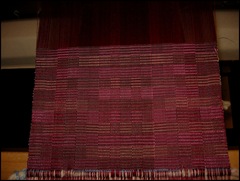
I needed to do more sampling.  I needed to try out all the different color distributions possible on any two given treadles.  I have not finished but here it is
sampling all treadling combinations

In order to make it easier to separate the blocks visually, I alternated pink and yellow for the pattern wefts. That is the first and all subsequent odd-numbered blocks I used pink for the two pattern treadles.  On the second and all subsequent even-number blocks, I used light yellow.  For the rest of the treadles I used a medium-dark green.

At first I didn't particularly enjoy this sampling.  The results seemed quite blah.  But still I knew that they would be helpful.  As I wove I began to grow more excited, so excited that I forgot about lunch---forgetting about lunch simply does not happen to me!   I think what is happening is just delightful!  What I may do for the Complex Weavers crackle exchange group is precisely what I am doing in this sample.   Maybe add a light green.  I have enough warp to weave it up for the fall exchange.

One thing I had not anticipated:  the neutralizing effect on the red warp of the green wefts.  This helps the pale yellow and pink blocks become more effective.  I knew about the concept of opposites neutralizing each other, but this is the first time I have seen it actually happening.

I am a very happy camper.  I am only angry that I have so many other things to attend to today that I cannot continue weaving.  On the other hand, it is nice to end the weaving being excited because that will carry over till tomorrow.  I always try, when possible, to stop in the middle of things, so to speak, because that makes starting again the next day so much easier.  Stopping with excitement is a gift.

To find out more about Complex Weavers' Crackle Exchange group, go here.

A NOTE ON RECENT PHOTOGRAPHY

I have not been happy with my photography lately.  The camera just didn't seem to work right.  Changing the color balance seemed to have no effect, which was so unusual that I began to think that the camera was in some respect broken.   And it was difficult to get a properly developed image where the colors weren't washed out.  The result is that I had to do more experimenting in Paint Shop Pro to get the likeness right.

Then I checked the digital information on the computer.  It said that the flash was on.  I knew it had been off and I wanted it off.  I checked earlier photos to make sure.  Yes, the flash was off.  So somehow, unintentionally, I inadvertently turned the flash back on.  Now i have to check the gosh-darn instructions to figure out how to turn it off. 

Related Post: 

A New Fiber Book Filled with Ideas
Third Sample Begun and Some Photography Issues
Photographing Textiles

© 2008

Posted August 20 , 2008 by http://talkingaboutweaving.blogspot.com/

Monday, May 26, 2008

SMALL PIECES

I notice that that Nicki, aka The Weaving Diva, has taken up the American Tapestry Alliance's challenge to weave a small tapestry. The maximum size allowed is 100 square inches.  That is indeed small.

So I can understand Nicki's reluctance to enter.  Go here to read about her hesitancy and her beginnings.

In this first post she includes part of ATA's statement about the requirements.  Here is a brief excerpt: 

"...the goal is not merely to rescale large work, but to explore the boundaries of size"

And go here to read about her progress. And a statement of what she hopes to do I find of particular interest in that post:

"I am hoping for a piece that will draw you in from afar and keep you interested when up close. I know it would work on a big piece. This may, however, be difficult to achieve due to the small format involved but it should be fun to try."

WHAT THIS MEANS FOR ME

Both these statements speak to what I am trying to do, even though I am not creating tapestry. 

  1. I want to create pieces that are small, not simply shrunken versions of larger pieces.
  2. I want to create pieces that are exciting to look at both from a distance and close up.

HGA has a similar challenge for its Convergence exhibit called Small Expressions 2008. HGA's intention here is

"...to showcase fiber art of a small scale not to exceed 15 inches (38 cm) in any direction."

My work is clearly falling into that scale.  Perhaps at some point I may create a piece to submit.  But not to the 2008 Convergence!  Something to work towards, perhaps?

Wednesday, May 14, 2008

CRACKLE SCARF MORPHS INTO...?

more woven

When I began weaving this crackle scarf, I kept looking at it. Looking at it with a question mark. I just didn't see a scarf. I didn't see the beginning of a scarf. I touched it. Frequently. It did not say "scarf." It kept saying---dare I say the words?--art piece.

There, I've said it. Saying it makes it more difficult for me to back away and change my mind. Saying it means commitment.

ART CLOTH VS ART PIECE

Constance Rose recently said it. Go here to read the post where she talks about her decision to commit to the creation of art cloth. Not art pieces; art cloth.

I Googled the phrase. Every site Google brings up links art cloth in some way with yardage and/or wearables. That is just how I viewed art cloth. I am not weaving art cloth.

I call what I am attempting to do an "art piece" because it will never have any connection with either yardage or wearables. (It won't even be a scarf). It will be closer to tapestry than to art cloth. But it will not be tapestry.

SELF-DELUSION IN SOLITUDE?

Am I simply deluding myself? Robert Genn sent out an email to his Painter's Keys subscribers. That email stopped me in my tracks. In it he talks about the dangers of working in solitude. Here is a passage that made my blood run cold::

"We all know of artists who are forever in a state of euphoric bliss about their essentially crummy art. These folks may rationalize that joy itself is enough, but it isn't. Pleasing yourself is loaded with potential self-deceit."

This is the danger of working in solitude. And since moving to South Carolina, I am definitely a solitary weaver.

TROUBLE IN PARADISE

However, while I may be finding myself in a "state of euphoric bliss," there is trouble in paradise. Trouble of a technical nature.

To read Genn's entire piece, called Kalopsia, as well as comments made by his readers, go here.

Related Links

Weaving and Art
Weaving as Fine Art
Fiber Art as Fine Art

© 2008

Wednesday, September 5, 2007

Fiber Art as Fine Art

Amount woven yesterday: 7.5"
Amount woven to date: 1 yard+29.5"


I accidentally found myself at a small fiber show last night. The show consisted of works by a Susan Lenz of Columbia SC. There were two kinds of work in the gallery. One kind consisted of arranging yarns, ribbons, threads across a dissolvable web and then free motion embroidering with her sewing machine over them. The result was something that looked remarkably like weaving. I loved the colors and textures. The pieces were mounted on white mat board. The mat board, in other words, did not cover the edges. The edges, in all their messiness were there for all to see. The messiness was not great, however. It was just enough to reveal the maker's hand. And the whole thing was framed. The fiber pieces themselves, without mat board or frame appeared to be about 12 inches wide by 30 inches tall.

The other kind of piece consisted of very small fabric squares. They appeared to be about one inch square. They were embellished with paints and free motion embroidery. They were then linked to one another with free motion embroidery. I assume the pieces were laid on dissolvable web and then the machine stitching was done. And I call it linking because there was space between each of the individual pieces. As with the previous type, the complete piece was placed on a white mat board and then framed. The size of these works as also about 12 inches wide by 30 inches tall.

Strange, I have been vaguely thinking about small weavings. Weaving with weavettes. Pin weaving. Perhaps I am reacting to weaving all this yardage?

I walked back to my car with renewed energy.

When I Googled Susan's name, I learned, much to my sorrow, that her current interest seems to be primarily altered books, though she is starting to play with quilting. Why this shift? I reflected on what I had seen. Yes, I really liked the stuff. And yes, her stuff made me think about what I was doing. But her stuff was all the same. She was really only repeating the same two ideas over and over again. There was no development. She must have been bored. I certainly would have been. She must have seen no possibilities for exploring in new ways what she was already doing. So she moved on to something different.

To learn more about Susan Lenz, check out her blog.