Showing posts with label 8-shaft crackle. Show all posts

Thursday, April 22, 2010

TIEUP QUADRANTS

Posted by Peg in South Carolina 

As I continued staring at the tieup in Smith’s draft, I slowly began to realize what I had been doing wrong: I had been trying to see a twill tieup pattern that went through all 8 treadles.  What I had forgotten was that I was dealing with each set of four shafts individually, not as a whole unit.

INCORRECT TIEUP

Here is my incorrect tieup.  It was based on trying to get diagonal lines to run through all eight treadles.  Well, it does, but only on the first two treadles. 

image

QUADRANTS AND CORRECT TIEUP

Here is the correct tieup. The diagonal is there on the first four treadles of the first four shafts.  And it is MIRRORED in the first four treadles on the second four shafts.  But what about treadles 5 through 8?  Here things are just reversed.  The lower left quadrant becomes the upper right quadrant and the upper left quadrant becomes the lower right quadrant. The result is that there is a twill diagonal which runs through each quadrant;  it just doesn’t run through the whole tieup.

image

So to read tieups like these I have to remember to think in terms of quadrants, not in terms of the whole.

I SHOULD HAVE KNOWN

The major irony is that I had already written about precisely this phenomenon in an earlier post!  Go here if you would like to read it.

Related Posts:  
Reading Smith’s Draft
Crackle in Parallel Shadow Weave

“Tieup Quadrants”  was written by Margaret Carpenter for Talking about Weaving and was originally posted on April 22, 2010. ©2010 Margaret Carpenter aka Peg in South Carolina

Wednesday, April 21, 2010

READING SMITH’S DRAFT

Posted by Peg in South Carolina 

I have finally worked enough with my drafts that I have been able to figure out how to read Smith’s draft.  I am clearly one who cannot think things through in her head but must actually DO something to work out a problem like this.

Anyway, her draft is really quite simply. Or at least, after long struggle, I realize now that her draft is quite simple!  It consists of the following block order:

A B C D C B

A point twill block order. And a threading with only one crackle unit in a block. Block A is omitted from the beginning because it will appear in the threading repeat. 

Well, of course I had to do this for myself, but repeating the units.  There is no way in working with 60/2 silk that I would use only 1 unit per block unless I were striving for an overall effect rather than a design.  And in actuality there would probably be many more.

And, so enlightened, I have designed from scratch my version of her threading.

image


I have used Smith’s block order (A B C D C B) and put in my blocks with their doubled units. This means that there are two units in each block instead of only one, as in Smith’s.  When I checked my version against Smith’s I caught some errors–-primarily points where I forgot to double the threads.  A lot of time passed while I did this…………

PROBLEM IN THE TIEUP

When I was finally satisfied that I had made no errors in my version, I checked the draft for floats.  Whoops, 7 floats.  I finally noticed they all occurred on the first treadle.  That meant that something was amiss with that tieup. image I looked.  The first thing I saw was that only three treadles were tied up.  So I needed to add a fourth treadle. 

I looked for a pattern in the tieup to help me figure out what shaft I should tie up to this treadle. I could not see the pattern.  So I experimented with where to put that fourth tieup.  Once I found the right position I saw the pattern and then saw also that one of the other tied treadles was wrong. Had I been thinking in terms of patterns at the time I wrote in the tieup, I would have caught the error immediately.

And here is what the draft looks like:

image

The draft looks fine except there is some kind of treadling issue.  Just below the center of the drawdown, things look a bit messy.   But checking out the treadling (yet once again!) is for another day.

COMPARING MY VERSION WITH SMITH’S

But then I looked at Smith’s drawdown.  Whoops!  My “brilliant” solution for the first image treadle’s tie up was………….WRONG!  The pattern I thought I saw was not there. 

But what does the drawdown look like now, with the corrected tiedown?


image  

Not really much different.   The floats are fine here as well.  And even the treadling mess seems possibly to have disappeared.  Still, I am going to have to check the treadling.  But not now.

ONE MORE PROBLEM:  THREADING

This fresh look at Smith’s version, after having created my own, showed something I had not picked up.  My threading on the first four shafts is exactly like hers.  But her doubling of threads pattern changes in the shadowing shafts, shafts 5-8.
 
In the shadowing shafts, she never doubles the top of the point;  that stays a single thread.  But she triples each bottom point.  I will not understand why until I finish working out my draft so that I can compare results.

Related Post:  Crackle in Parallel Shadow Weave


“Reading Smith’s Draft”  was written by Margaret Carpenter for Talking about Weaving and was originally posted on April 21, 2010. ©2010 Margaret Carpenter aka Peg in South Carolina

Friday, April 16, 2010

CORRECTED THREADING

Posted by Peg in South Carolina 

Here is the full draft of the version with the corrected threading.

image

    image


In the third threading block, I needed to double the ends of shafts 3 and 7 where one of the points of that crackle twill unit in.  When I am dealing with the following crackle units, I always have trouble figuring out things. 

1. The third crackle unit threading in this draft:  1 4 3 4
2. The fourth crackle unit threading in this draft:  1 2 1 4

In the first threading unit (1 2 3 2 1) and in the second threading unit (2 3 4 3 2) it is visually clear to me where the turning points are.  But visually, it is not so clear to me in the third and fourth units.  Just a funny quirk in the way my mind works, I guess.

And here is the miniaturized version of draft with the corrected threading but with the treadling doubled at the points to reflect the threading.

image Correcting the threading did nothing about the slant on the left side of the draft, but it did eliminate the messy business between that slant and the horizontal effect right side of the draft.


Related Post:  Crackle in Paralle Shadow Weave Drafts Compared

(Yes, I made a mistake in the title of the post. I should correct it…………..)

“Corrected Threading”  was written by Margaret Carpenter for Talking about Weaving and was originally posted on April 16, 2010. ©2010 Margaret Carpenter aka Peg in South Carolina

Wednesday, April 14, 2010

CRACKLE IN PARALLE SHADOW WEAVE DRAFTS COMPARED

Posted by Peg in South Carolina

(Blogger has done something strange to two of the photos.  Clicking on them will displaly the images as they should be)

I have now worked out three different ways of doing this particular crackle-in-parallel-shadow weave draft.  The first is the original, the one that appeared in the last post.

image

In this next one If have changed the threading by doubling the threads at the points of the crackle units, as Dorothy Smith has done in her draft.  But I retained my original treadling which was a treadling of the original threading.

image

The only difference is that the figures formed by the color-and-weave effect are a little bit flattened because each threading unit now has one or two more threads in it than the original had but there are the same number of treadles.

And here is the third in which the treadling is changed as well in order to reflect the change in the threading.

image


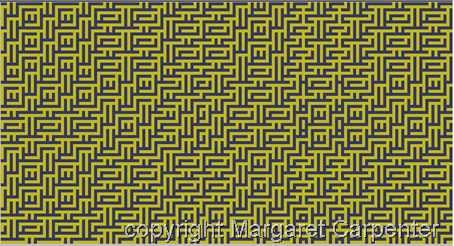
Here we have quite a different design from the original.  This is less of a maze effect and more of an overall pattern.

USING 60/2 SILK

Here is what the first and third drafts look like reduced in size to reflect more closely what they might look like woven up in 60/2 silk.

image
       image

60/2 silk is normally sett somewhere between 56 and 72 ends per inch.  The draft on the left has 72 warp ends.  On my monitor its width is slightly more than 1 inch.  So that image should give a pretty good idea of what it would look like woven.  The second draft is 1.25” so again, a good idea of what it would look like woven.

You can, by the way, also get this affect by moving away from your computer monitor and squinting…….  This is a good old-fashioned artist’s way of cutting to the chase!
At the moment, I can see two possible ways of using these drafts if I want to weave them in 60/2 silk: 
1. Use two close shades of the same color so that the overall effect is of one color, but a bit richer looking.  There are weavers who do this with pain weave warps.
2. Use 2 colors that would create an overall iridescent effect.
ANOTHER PROBLEM REVEALS ITSELF

The draft on the right, when I reduced it, surprised me, because the design breaks in half.  The left has a definite diagonal thrust to it.  But on the right side the design effect is level.  And there is a bit between the two that is just kind of messy looking.

Looking at the larger draft shows this as well.  It just didn’t hit me until I reduced its size. This does not happen in either the first or second versions.  And closer examination of both this third draft and the second draft reveals another problem. 

Looking at the third and fourth treadling blocks in the area of the third threading block shows that the two units of the threading block have different appearances.  So, while I have corrected the treadling problems, there is apparently a threading error in the third threading block from the right.  And indeed, looking more carefully  shows that the same thing is true of that third threading from the top to the bottom of the draft.

Time to take a look at the threading.


“Crackle in Parallel Shadow Weave Drafts Compared”  was written by Margaret Carpenter for Talking about Weaving and was originally posted on April 15, 2010. ©2010 Margaret Carpenter aka Peg in South Carolina

Monday, April 12, 2010

THE HARD WORK OF DRAFT DESIGNING CORRECTED

Posted by Peg in South Carolina

I pressed the publish button on the last post too soon.  I went back to the draft to work out some other things and found……………one more treadling error.  I do trust that this is the last one my eye will pick out!

So, here is the—hopefully—final version of my first parallel shadow weave crackle draft.

image


Related Post:
   The Hard Work of Draft Designing


“The Hard Work of Draft Designing Corrected”  was written by Margaret Carpenter for Talking about Weaving and was originally posted on April 12, 2010. ©2010 Margaret Carpenter aka Peg in South Carolina

THE HARD WORK OF DRAFT DESIGNING

Posted by Peg in South Carolina

I am finding that designing drafts is hard work.   Tedious work.  A part of me does not want to continue with the current project.  It is just too tedious.  Add to that the fact that right now I cannot spend a lot of time at the computer; although they are significantly better, I still need to protect my right hand, arm, and shoulder.  I am virtually symptom-free, but I do not want the pain to return.

Of course, that is a good excuse for avoiding work.  And I am very good at avoiding this kind of work.

But I did get to work, and, much too my astonishment, the correction came quite easily.
image
The problem lay not in the threading, as I was beginning to think, but in the treadling.  That was where the first problem lay.  But this time it lay in the treadling of the third block. The third block (which consists of two treadling units) is indicated between the two arrows.  The upper arrow points to the beginning of the third block on treadle 4;  the lower arrow points to the end of the third block on treadle 1.  I am referring only to the treadles on the first four shafts.  To the right of each of those treadles is the shadowing treadle on the second four shafts.


NOTE:  Go here to read corrected post.

“The Hard Work of Draft Designing”  was written by Margaret Carpenter for Talking about Weaving and was originally posted on April 8\12, 2010. ©2010 Margaret Carpenter aka Peg in South Carolina

Wednesday, March 17, 2010

8-SHAFT CRACKLE TREADLED ON OPPOSITES

Posted by Peg in South Carolina

image

Note that these treadles are not truly opposite sheds.  In every case, there is overlapping of shafts.  This means that there are some excessive warp floats.  And that means that tabbies need to be used.

Here is a better image of the reduced-size drawdown.  image

That image shows with greater clarity the interrupted diagaonal in the bottom half of the image.  Some investigation is in order.

"8-Shaft Crackle Treadled on Opposites”  was written by Margaret Carpenter for Talking about Weaving and was originally posted on March 16, 2010. ©2010 Margaret Carpenter aka Peg in South Carolina.

Tuesday, March 16, 2010

S&W: ANOTHER WAY TO USE COLOR

Posted by Peg in South Carolina


image


To the right is a better image of the reduced sized draft.  Even so, this is not as good asimage others I have used.  I think that the highly contrasting red must create color rendition problems? 

Microsoft Publisher is clearly fine if I want to include a full-scale draft.  But the more I reduce the image, the more problematic the image becomes.  Even the actual colors are not the same.

I am looking into other publishing software programs……..

Related Post:    S&W Treadling and Color


"S&W: Another Way to Use ColorS&W: Another Way to Use Color was written by Margaret Carpenter for Talking about Weaving and was originally posted on March 16, 2010. ©2010 Margaret Carpenter aka Peg in South Carolina.

Monday, March 15, 2010

S&W TREADLING AND COLOR

Posted by Peg in South Carolina
image 
IMAGE PROBLEMS WITH MICROSOFT PUBLISHER
It has become clear to me that Microsoft Publisher has a definite problem with images, or at least images created with weaving software.  Just below is the image on the right hand side of the above page, saved as a png file and brought into my blogging software (Windows Live Writer).  It looks perfectly fine--just like the JPEG files I bring into my blog.

8-shaft crackle red warp

I looked at Publisher to see if there was a way I could export images into its pages instead of copying and pasting.  The only thing I could find was an Insert picture function.  That is pretty much how I bring images into my blogging software.  But when I tried it with Publisher, there was only the slightest improvement in reproduction.

I do not have the latest version of Publisher, but when I checked, that version has a graphics manager which, from its description, sounded like it might handle my problem. But then I found this disclaimer:
If you want to insert a picture from another program, you can copy and paste it. The pasted picture might not appear the way you expected, but copying and pasting may be the best way to use a picture from a program that is not part of the 2007 Microsoft Office system. (Go here to read more).
Soo…..it looks like I live with the problem or find another program, a non-Microsoft program…….


"S&W Treadling and Color” was written by Margaret Carpenter for Talking about Weaving and was originally posted on March 15, 2010. ©2010 Margaret Carpenter aka Peg in South Carolina.

Friday, March 12, 2010

MORE SUMMER AND WINTER TREADLING

Posted by Peg in South Carolina 

image


Here, with all the blocks treadled, the twill diagonal is once again visible.

“More Summer and Winter Treadling” was written by Margaret Carpenter for Talking about Weaving and was originally posted on March 12, 2010. ©2010 Margaret Carpenter aka Peg in South Carolina.

Thursday, March 11, 2010

8-SHAFT CRACKLE TREADLED SUMMER AND WINTER

Posted by Peg in South Carolina

image

The image in the lower left-hand corner is simply a reduced version of the drawdown.  I included it because it gives a better idea of what it might look like woven as fabric.

Keep in mind that black is warp and white is weft.

Related Post:  Summer and Winter…and Crackle (of Course!)

“8-Shaft Crackle Treadled Summer and Winter” was written by Margaret Carpenter for Talking about Weaving and was originally posted on March 11, 2010. ©2010 Margaret Carpenter aka Peg in South Carolina.

Wednesday, March 10, 2010

Friday, March 5, 2010

CUTTING AND PASTING TO EXTEND THREADING

Posted by Peg in South Carolina 

image

I did the cutting and pasting in Microsoft Publisher, the software I have been using for this crackle journal.  It is not the best job of pasting but it might actually be useful for me to see exactly where the divisions are.

I can see cutting and pasting weaving drafts as a useful tool for designing complex threadings.  The technique could be done in any software that allows cutting and pasting as well as rotating and flipping of images.

Related Post:  Color and Crackle Curves


“Cutting and Pasting to Extend Threading” was written by Margaret Carpenter for Talking about Weaving and was originally posted on March 5, 2010. ©2010 Margaret Carpenter aka Peg in South Carolina.

Thursday, March 4, 2010

COLOR AND CRACKLE CURVES

Posted by Peg in South Carolina 

I had done some playing with color gradations in crackle earlier.  See my post, “Shading the Pattern Weft Yarns” for what I did there. I had liked playing with color gradating there, so I decided to try it here.  This is just a rough sketch.

image


If you go to the earlier post, you can see that I have become a bit more complex in my playing. 


“Color and Crackle Curves” was written by Margaret Carpenter for Talking about Weaving and was originally posted on March 4, 2010. ©2010 Margaret Carpenter aka Peg in South Carolina.

Wednesday, March 3, 2010

DIAMONDS TO CURVES

Posted by Peg in South Carolina 

image

This started out as an attempt to see what would happen if I varied the number of treadles in the different treadling blocks.  I learned that I could create curves that way, something I had not anticipated.

I had played with varying the number of treadles in 4-shaft crackle, but certainly did not come up with anything like this.  Go to the post, 4-Shaft Crackle 01.12.10 to see what transpired there.

TABBIES

By the way, tabby is needed but not indicated.  It is needed because those long warp ends (the black threads) need to be tied down. 

Tying down the warp ends with tabbies will have another affect as well.  It will break up those narrow black/white bands so that they will look a bit more like plain weave.  Depending on the color and the fineness of the tabby wefts, they will also to some extend break up the pattern.  If I use tabbies the same color as the warp, the black pattern blocks will be little affected.   If I uses tabbies the same color as the weft, the white pattern blocks will be little affected.


“Diamonds to Curves” was written by Margaret Carpenter for Talking about Weaving and was originally posted on March 3, 2010. ©2010 Margaret Carpenter aka Peg in South Carolina.

Tuesday, March 2, 2010

DIAMOND POSSIBILITIES COMPARED

Posted by Peg in South Carolina 

image


Who would ever have thought that more than four shafts could be a disadvantage in designing?!


“Diamond Possibilities Compared” was written by Margaret Carpenter for Talking about Weaving and was originally posted on March 2, 2010. ©2010 Margaret Carpenter aka Peg in South Carolina.

Monday, March 1, 2010

Friday, February 26, 2010