Showing posts with label twill. Show all posts

Wednesday, April 20, 2011

THANK HEAVEN FOR DOCUMENTATION

Posted by Peg in South Carolina

And thank heaven for the wonderful search function in Windows 7 which quickly brought up my files on the acrylic baby blanket I woven several years ago for our grandson.

And why should this matter?

Our church has started a prayer shawl group.  I went to the first meeting, but when the meetings were set on a day I could not come, I fully expected I would knit on a prayer shawl at home.  The more I thought about it, the less I liked it.  I have too many other things right now that I would rather knit and not enough loose time (i.e., car travelling, doctor waiting, etc.) to do it all.  But…………..

I could weave one!

The baby blanket I had made provided the perfect model.  Machine washable, the right grist.   Perfect.  So I worked out the numbers.

image


I was going to wait a bit before ordering the yarn.  And then I thought, no, do it now.  So I ordered to cones, one a light dusty blue, one a medium blue.  I will weave large checks of these two colors.

But…………..the current warp still has to come off the loom.  I am getting close to actually doing it!

Related Post: Reflections on the Baby Blanket


Thank Heaven for Documentation” was written by Margaret Carpenter for Talking about Weaving and was originally posted on April 20, 2011. ©2011 Margaret Carpenter aka Peg in South Carolina

Wednesday, April 21, 2010

READING SMITH’S DRAFT

Posted by Peg in South Carolina 

I have finally worked enough with my drafts that I have been able to figure out how to read Smith’s draft.  I am clearly one who cannot think things through in her head but must actually DO something to work out a problem like this.

Anyway, her draft is really quite simply. Or at least, after long struggle, I realize now that her draft is quite simple!  It consists of the following block order:

A B C D C B

A point twill block order. And a threading with only one crackle unit in a block. Block A is omitted from the beginning because it will appear in the threading repeat. 

Well, of course I had to do this for myself, but repeating the units.  There is no way in working with 60/2 silk that I would use only 1 unit per block unless I were striving for an overall effect rather than a design.  And in actuality there would probably be many more.

And, so enlightened, I have designed from scratch my version of her threading.

image


I have used Smith’s block order (A B C D C B) and put in my blocks with their doubled units. This means that there are two units in each block instead of only one, as in Smith’s.  When I checked my version against Smith’s I caught some errors–-primarily points where I forgot to double the threads.  A lot of time passed while I did this…………

PROBLEM IN THE TIEUP

When I was finally satisfied that I had made no errors in my version, I checked the draft for floats.  Whoops, 7 floats.  I finally noticed they all occurred on the first treadle.  That meant that something was amiss with that tieup. image I looked.  The first thing I saw was that only three treadles were tied up.  So I needed to add a fourth treadle. 

I looked for a pattern in the tieup to help me figure out what shaft I should tie up to this treadle. I could not see the pattern.  So I experimented with where to put that fourth tieup.  Once I found the right position I saw the pattern and then saw also that one of the other tied treadles was wrong. Had I been thinking in terms of patterns at the time I wrote in the tieup, I would have caught the error immediately.

And here is what the draft looks like:

image

The draft looks fine except there is some kind of treadling issue.  Just below the center of the drawdown, things look a bit messy.   But checking out the treadling (yet once again!) is for another day.

COMPARING MY VERSION WITH SMITH’S

But then I looked at Smith’s drawdown.  Whoops!  My “brilliant” solution for the first image treadle’s tie up was………….WRONG!  The pattern I thought I saw was not there. 

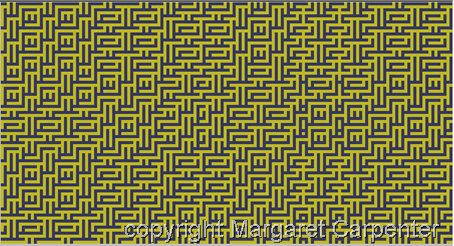
But what does the drawdown look like now, with the corrected tiedown?


image  

Not really much different.   The floats are fine here as well.  And even the treadling mess seems possibly to have disappeared.  Still, I am going to have to check the treadling.  But not now.

ONE MORE PROBLEM:  THREADING

This fresh look at Smith’s version, after having created my own, showed something I had not picked up.  My threading on the first four shafts is exactly like hers.  But her doubling of threads pattern changes in the shadowing shafts, shafts 5-8.
 
In the shadowing shafts, she never doubles the top of the point;  that stays a single thread.  But she triples each bottom point.  I will not understand why until I finish working out my draft so that I can compare results.

Related Post:  Crackle in Parallel Shadow Weave


Reading Smith’s Draft”  was written by Margaret Carpenter for Talking about Weaving and was originally posted on April 21, 2010. ©2010 Margaret Carpenter aka Peg in South Carolina

Tuesday, December 8, 2009

TWILL LINE

Posted by Peg in South Carolina

Twill line visible

I am working at getting 12 picks per inch.  What I had intended to do was to use my right angle rectangle to place against the fabric to check the angle of the twill.  But this fabric is so busy with all its nubs that I cannot see the angle. At least not when I am looking straight down at the fabric.  For all anyone might care, this reads simply as plain weave.

But I wanted to weave twill, because the twill structure, even though the fabric does not read as twill, will allow the fabric to hang nicely around the neck.

I discovered quite by accident that if I looked at the woven fabric on the loom from a certain angle, I could clearly see the twill line.  So I tried to get it on a photograph.  After many failed attempts, I finally got this one.  If you look at the left side of the fabric, the twill line is visible.


"Twill Line” was written by Margaret Carpenter for Talking about Weaving and was originally posted on December 8, 2009. ©2009 Margaret Carpenter aka Peg in South Carolina.

Thursday, February 5, 2009

DESIGN CONTINUED: HOW MANY BLOCKS?

Posted by Peg in South Carolina

My attention may be on the handspun shawl I am getting close to being able to warp, but I still continue to think and make notes about the silk crackle shawl which will follow. Here are some of the issues I am concerned with.

1. NUMBER OF THREADING BLOCKS

The most immediate issue is to determine how many blocks across the width of the warp I want. The art pieces, all of the based on Zielinski’s notion of creating 8 crackle blocks on 4 shafts, consisted of 17 blocks across the warp, but that was a much narrower warp. This shawl will be 28” wide.

2. SIZE OF BLOCKS

But even before I can decide the number of blocks, I need to determine how many units in each of the blocks. Yes, I do plan (at least at this point) to keep each block the same size. To determine the number of units I need to determine how wide I want the blocks.

3. ENDS PER INCH (EPI)

The epi for the shawl will be different from that for the art pieces: 60 epi instead of 72. 72 epi is generally the best setting for 60/2 silk woven in a twill pattern. Since I am weaving this crackle in what is essentially twill fashion, 72 would be the right sett. And it worked quite well for the art pieces.

But weaving a much wider piece at the same sett as a narrow piece would, for me, create difficulties. More difficult because it would be easier for the closely sett warp ends to hang up on each other and so create bad sheds. It would also be much harder to pack in the weft on the wider piece than on the narrow piece. So I have decided to make life a bit easier for me and sett this shawl at 60 epi. I will also consider using a temple to help with both issues.

Changing the epi from 72 to 60 will in and of itself make the blocks a bit wider. But my inclination is to make the blocks even wider because of the larger proportions of the shawl. So I am for now settling on 10 units per block. With 4 ends in an individual crackle unit, plus 1 accidental end at the end of any given block, that would result in a block being 41 ends wide. That means a block would be approximately 2/3-inch wide. With 44 blocks, I would get a shawl requiring 1,804 ends, four more ends than I had originally planned on in order to achieve a shawl with a final width (off loom and washed) of 28”.

4. ORDER OF THE BLOCKS

I have also made another design decision regarding the blocks. I had intended on trying ordering the blocks differently from that in the art pieces. There they were aligned in straight twill order, but reflected:

A B C D E F G F G F E D C B A

And in reflecting, the center of the scarf had some repeating blocks which created a change in the design there. Always wanting to try something a little different, I started to think about changing the order. But then sanity prevailed. The weaving itself is going to be a challenge, and by weaving, I mean, the planning of the treadling combined with the colors. I have physically available to me what can happen with threading twill order reflected. But not any other kind of threading. So I am going to stick to the concept of straight twill reflected.

But just how and where and how often that reflecting process will happen—in other words, the actual block order—I have not decided.

Related Posts:
Temples
Temples (these are two different posts!)
Much Ado About Not a Whole Lot
Threading Four-Shaft Crackle
8 Crackle Blocks on 4 Shafts


"Design Continued: How Many Blocks?” was written by Margaret Carpenter for Talking about Weaving
and was originally posted on February 5, 2009. ©2009 Margaret Carpenter aka Peg in South Carolina

Tuesday, December 9, 2008

TOWEL 5

Posted by Peg in South Carolina

Towel 5 almost woven With this towel, my concentration began to flag. I had trouble keeping track of the count.

COUNTING

Basically I’ve been counting 1-and-1-and for the first of the four shots. 1 is the first treadle, and is the second, 1 is the third, and is the fourth. These are the four treadles I have tied up for the weave. Then I count 2-and-2-and and keep going till I finish with 5-and-5-and. Then I click my knitting counter. I do this 3 times. I will then have clicked my knitting counter 3 times. Then I weave 1-and through the second 2-and. And then 2 more treadles. But before I do these last 2 treadles, I measure, just to make sure. The second group 3 x 4 treadles is a little different, because I start with the second of the group. This means I end with the second of the group. And, before I do those last two, I measure.

This is really very simple and has served me well for the first four towels. But with this fifth towel I tended to make mistakes. More and more often I had to rely on measuring. Relying on measuring works, but I would like to figure out how to revive interest so that my attention does not flag. Perhaps a different way of counting?

IF YOU CAN’T DO IT PERFECTLY…….

This towel is quite different from the first four. The squares are white and the horizontal lines are blue and green. My intent was that the blue and green alternate. I did the first blue. I did the second green. I did the third blue. I did the fourth blue………. But I didn’t realize the error until I was almost finished weaving the next square.

Unwilling to unweave, I followed Laura’s dictum: if you can’t do it perfectly, do it consistently. So I have wove 1 green line and 2 blue lines. And who is to say that is imperfect? Who, except you the reader of this blog, who would know what the original intent was? Case closed.

Towel 5 beating

BEATING

One of the things I noticed as I was weaving this towel is that the wefts do not lock in place as you weave. The last 3 wefts woven are a bit loose and nothing in the world will change that. But everything woven prior to those 3 wefts is just fine. I read once that when you beat, you are not beating in the weft just thrown but the weft 3 or 4 rows back. Now I understand what that means. Clicking on the picture to blow it up should reveal more clearly what I mean.

DENTING EFFECTS

The photo also shows (actually more clearly than the live fabric does) the effect of 2 ends in a dent. Little dark lines run down the photo, enclosing 2 ends with each pair of lines. These should come out in the wash.


"Towel 5" was written by Margaret Carpenter for Talking about Weaving and was originally posted on December 9, 2008. © 2008 Margaret Carpenter aka Peg in South Carolina

Wednesday, November 26, 2008

SECOND TOWEL WOVEN

Posted by Peg in South Carolina

Towel 2 begunFor this scarf, instead of using burnt orange for the main color I am using a medium blue.

I am still enjoying the novelty of fast, easy weaving, with the monotony relieved by inserting the bands of white.

WEAVING PERFECT SQUARES

I had been looking for squares that were perfectly square, but this is probably not going to happen.  I think the draw-in will be greater than the take up. Thus, even though the squares measure the same each way while on the loom, they will probably become a bit more rectangular once off the loom.

There is only way that might have guaranteed perfect squares: weaving a sample at the beginning of the warp, cutting it off and washing and pressing it. And I might have had to do this more than once. Perfect squares were just not that important to me.  So I am again abiding by Laura Fry’s dictum that if you can’t weave it perfectly, weave it consistently.

COUNTING AND MEASURING

To that end I am both counting and measuring.  I know how many shots go in a square, but to make it easier, I do not count individual shots.  Rather, I count each set of 4 treadles.  When I get to 5 (I read these as 5 groups), I note that as 1 on my knitting counter. My knitting counter hangs around my neck so I never have to look for it.  I then weave another set of 5 groups and note that as 2 on my counter.  Then another and note that as 3.  Then I need to weave 2 groups of 4 treadles followed by 2 treadles.  But, before I do those extra 2 treadles, I measure.

Measuring and treadling should match.  If they do not, measuring trumps treadling.

On the first towel, I occasionally did not need those extra 2 treadles. On the second towel I just finished, I only occasionally had to use them. Aha, again my weaving is not perfect!

I do wonder, however, if the blue yarn was ever so slightly thicker than the burnt orange.  Spinning mills are not perfect either….

FLOATING SELVEDGES

Half way through this second towel, the floating selvedges loosened enough to force me to weight them.  I was curious how long I would have to weave before weighting was required.  Now I know.


"Second Towel Woven" was written by Margaret Carpenter for Talking about Weaving and was originally posted on November 25, 2008. © 2008 Margaret Carpenter aka Peg in South Carolina

Monday, November 24, 2008

TOWEL ONE WOVEN

Posted by Peg in South Carolina

Towel 1 begun Weaving these towels is very different from the weaving I normally do. First of all, it is really fast!  Well, not as fast as Laura Fry weaves, but certainly a lot faster than the crackle I have been weaving.

I recently purchased Laura Fry’s latest CD.  One of the things on it is a video clip of Laura weaving.  Talk about fast weaving! If I were interested in doing production weaving where speed was essential, I would definitely use Laura’s performance in this video clip as my model.  I would look at it and try to imitate.  Look again, refine the imitation.  And so on. By the time I get to the fifth towel on this warp, I may be looking at how to speed things up…. To learn more about Laura’s CD, go to her website here.

Another thing that I am finding intriguing is the slant of the twill.  Since I sett the yarn at 24 epi, I intended to weave it at 24 ppi.  This would give me the 90-degree angle twill I was after.  Well, it’s close.  But the ppi is 20.  And while I am not slamming the beater into the fell, I am beating quite hard. 

The cause of this is no doubt in the draw-in.  There is quite a bit of draw-in and the selvedges have closed up considerably.  So it is probably the closeness of the selvedge threads that is preventing me from easily beating any more weft into a given inch.

I could use temples to keep the warp yarns spread out during the beating.  But I am weaving towels.  Towels that I hope will get hard use.  Those tight selvedges will protect the edges of the towels very nicely. 

One thing Laura said on her CD which I take to heart:  if you can’t do it perfectly, do it consistently.

By the way, while the color in the cloth is accurate, the color of the floor is definitely NOT accurate!

"Towel One Begun" was written by Margaret Carpenter for Talking about Weaving and was originally posted on November 24, 2008. © 2008 Margaret Carpenter aka Peg in South Carolina

Friday, September 26, 2008

DESIGNING THE CHRISTMAS TOWELS YET AGAIN

Posted by Peg in South Carolina

As I come slowly to the end of the silk crackle, I realize that the loom is about to be empty. Well, OK, at the rate I weave, it will probably still be a few more days before the loom is empty. At any rate, I really like to have a warp ready to go on the loom before I am finished with the current project. So I decided to get to work on our daughter’s Christmas towels.

My first plan, discussed here, way back in May, had been to do color-and-weave. A month later, I had changed my mind and decided to do simple twill. To read about this change in plans, go here. But by early July I was starting to think about crackle, as you can read here.

Crackle seemed to be the final choice. Certainly it seemed a logical choice considering my current obsession with crackle! So here and here, I considered yarn choices. I figured out the block design I wanted. Then I made the warp calculations here. I made the weft calculations here.

And now?

I’m back to simple 2/2 twill.

Why? Because, unlike crackle, the floats are limited to two. Because, while 2/2 twill creates a firm fabric, at the same time it creates a fabric supple enough for the dryer of dishes to get easily into the nooks and crannies of the dishes.

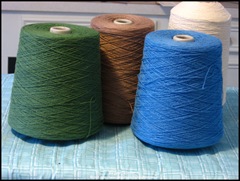
The design itself is a simple one--inspired by a photo on page 26 in Sharon Alderman’s Mastering Weave Structures. This fabric a wool check designed in browns and grays and is very elegant. The wool yarn, of course, is not suitable for towels, but neither are the colors. Instead, I The cones of yarnwill use 8/2 unmercerized cotton; and these towels will use the colors in the photo at the left. One color is missing—a yellow—and is on backorder.

The warp will consist of the white cotton, separated approximately every 3.5 inches by 2 ends of ? Well, I haven’t quite decided that yet. I’m thinking brown. The weft stripes could be the same brown or the blue or green or yellow. The weft 3.5 inch checks could be white, blue, green, or white. Or I could weave a solid weft in one of those colors. And because there will be so few warp ends involved in the striping (a total of 20), the idea of changing those colors in midstream is within the realm of possibility.

Each towel is going to be different.

A POST NOTE ON PHOTOGRAPHY

When I photographed the above cones close up, the cones on the left slanted to the left and those one the right slanted a great deal to the right. Talk about being drunk!

But when I stood farther back and used the camera to zoom, the distortion disappeared. Well, no. It didn’t completely disappear, but it certainly improved.

This has me very curious.

  1. Why does this happen?
  2. How can I correct it in the software?

Ideas are welcome!


Related Post: Authoritative Statements


"Designing the Christmas Towels Yet Again" was written by Margaret Carpenter for Talking about Weaving and was originally posted on September 25, 2008. © 2008 Margaret Carpenter aka Peg in South Carolina

Tuesday, June 17, 2008

RECIPES

"Recipe gatherers are not always open to the trial-and-error part--I call it 'commit and correct'. These days folks often feel they need to save themselves some time. This can be false economy. Selling everyone on commit and correct is not easy. It's all about creativity, and that's the fun part."

Robert Genn, in his essay Keeping Things Simple, is talking specifically about gathering recipes for creating colors with oil paints. But I hear him speaking to me, a weaver, as well.

I want to weave some towels for our daughter. There are recipes for towels galore. How easy it would be just to pick one I like and weave some, following that person's recipe. This should be pretty fail-safe. And it would save me a lot of time as well. Very tempting. I could get back to my crackle playing so much faster.........

Genn reminds me, however, that "the fun part" is the working out of design and structure issues for myself. Even if the end product should turn out to be a disaster I wouldn't allow my dog to sleep on and chew up, I would have learned much of value, not least of which would be how to suffer disaster wisely.

I have certainly learned this in my crackle weaving. But towels? Why should I spend a lot of time designing some simple towels?

How much time would it take for me to draft a straight twill for a solid color warp for 8/2 unmercerized cotton, measure one of my towels for size, and work out the warping details? Probably no longer than it would take for me to settle on a design created by someone else.

Then for fast weaving I would weave each scarf with one color, a different color for each scarf. And I would weave each scarf with a different treadling.

Not fancy towels, probably. But honest towels.

To read Genn's whole piece, go here.

Related Post:

Color and Weave
Thoughts on Designing

© 2008