Monday, March 10, 2008

TROMP AS WRIT VARIED


YARN WEIGHTS

This time I have used 20/2 pearl cotton as both pattern and binder weft. This is not at all traditional. The heavier weft is traditional. But I like the results. Indeed, I have been liking the results of weaving with 20/2 so much that I have put off dyeing the wefts because I am not sure that I will be using a heavy weft for pattern when I turn to the silk. Before I make a final decision, I want this sample off the loom, washed, and pressed so that I can better evaluate the differences.

COLORS

I used six colors, rotating them so that with each new treadling block, I dropped one color and added another. The colors I used were a darkish blue, orange, yellow, a slightly blued green, yellow green, and aqua.In the case of this tromp as writ treadling, I like the rather misty effect that has happened.

MISTY EFFECT

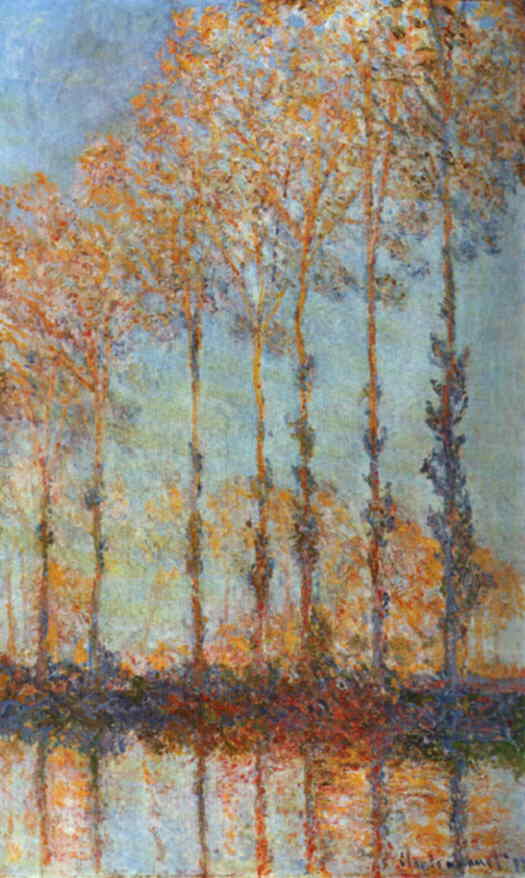
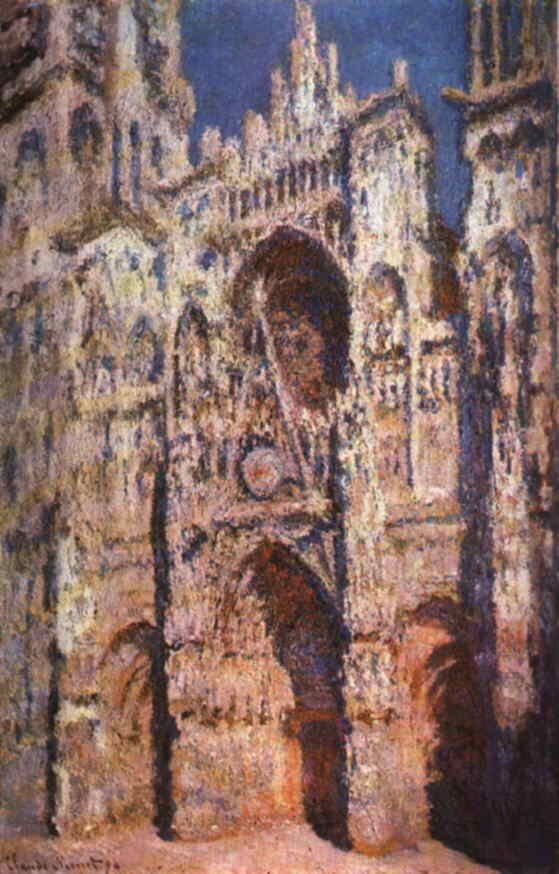
This misty effect is quite the opposite of my more typical work. Go here, for example, to see a picture of what of the earlier samplings on this warp. Or here for a photo of one of my favorite crackle scarves. These images are much more typical of my work. The misty effect of this latest sampling reminds me just a bit of some of the foggy kinds of paintings that Claude Monet did.

This is a good website to view some of Monet's paintings. Check out especially Poplars on the Epte and Rouen Cathedral.

I have always adored the impressionist painters. Is this love beginning to enter into my weaving? We shall see.

TREADLING

I defined the treadling pattern as "tromp as writ." Actually, that is not strictly true, for I did not take the treadlings in order. Instead, I alternated treadling blocks till I finished the sequence. Then I returned to the beginning to pick up the remaining omitted treadling blocks.

To read a bit more on tromp as writ go to Heritage Yarns . Scroll down to near the bottom of the page and you will find a good disucssion of this in terms of overshot threadings.

Related Post: "Tromp as Writ"

Friday, March 7, 2008

CRACKLE THREADING REVIEW

For those who have just dropped in (or not) and have no idea what is going on at this moment, here is the crackle threading I am using. It is a threading which creates 8 blocks while using only 4 shafts.


If you are at all familiar with 4-shaft crackle, you probably wonder, what the..........? Here is what the usual 4-shaft crackle threading is more likely to look like:


This second threading is standard 4-shaft crackle threading. The first is not.

That first threading is not original with me. I learned of it in a book by Zielinski. To learn more about this unusual threading, go to a couple of earlier posts:

8 Crackle Blocks on 4 Shafts
8 Crackle Blocks on 4 Shafts Continued

If you want to learn a bit about the more usual 4-shaft crackle, try this post:

Threading 4-Shaft Crackle

Thursday, March 6, 2008

MORE POLYCHROME TREADLING


I while back I wove polychrome on this warp. Then I used 10/2 pearl cotton for weft. This time I have used 20/2 pearl cotton for weft.

THREE COLORS CHANGING

In each block I used three colors, just as I had in my earlier explorations. But these explorations are more complex than the earlier ones. Now,, each time I moved to a new block I have (somewhat) systematically dropped one color and added a new one, keeping the other two the same.

The first block (beginning at the bottom uses blue, orange and aqua. The next block uses green, orange and aqua, the next block uses blue, green and orange, the fourth block uses aqua, blue, green, and so on.

I rather like what I see happening The result does not quite work as a whole, but it does encourage me in this kind of exploration.

WARP RIB EFFECT

One thing to keep in mind is that the red warp alternates (unintentionally!!!) 10/2 and 20/2 pearl cotton . One of the effects of this is a slight lengthwide ridged/ribbed effect. This effect is most noticeable when touching the fabric.

Also observable is that in some places the warp goes way into the background and is hardly noticeable. That is when the treadling causes the 20/2 warp shows on top. But when the the treadling causes the 10/2 warp to come to the top, the red warp is much more noticeable. Something to play with another time, perhaps.


Related Posts:
Polychrome Crackle with Blue Weft
8 Crackle Blocks on 4 Shafts: More Polychrome Treadling
8 Crackle Blocks on 4 Shafts Continued

Wednesday, March 5, 2008

SHUTTLE RESTS


Here are the two shuttle rests I made for my loom. They are held onto the loom with C-clamps, one on the right side and one on the left side. They are different sizes only because I found the pieces in the odd lots at Home Depot and I simply guessed what size needed.

The one on the left is larger and holds fairly easily three shuttles. The one on the right and, as you can see, easily holds only two shuttles. Sitting on it are two pattern shuttles. Sitting on the web itself are two binder shuttles. It is fairly simple to keep these four shuttles in order.

I never answer the phone when I am in the midst of a sequence.


Related post: Resting Shuttles

Tuesday, March 4, 2008

LOOM IMPOSED ORDER

Not long ago I received an email from Robert Genn which ended with the following quotation from Francis Bacon:

Great art is deeply ordered. Even if within the order
there may be enormously instinctive and accidental things,
nevertheless they come out of a desire for ordering and for
returning fact onto the nervous system in a more violent way.


One of the things about weaving is that by its very nature, it seems automatically to impose order on the final piece. The ordering I am talking about is the ordering imposed by the straight lines of the warp and the straight lines of the weft.

I am always struggling, it seems, to overcome the ordering of this loom imposed grid. I am always trying to find ways to overcome this rigidity. I am always trying to get "instinctive and accidental things" into my weaving.

SAORI WEAVING

This is why, I suspect, many people are drawn to Saori weaving. This is weaving that is based on improvisation and lack of planning. Bonnie Tarses had a go at this a while back and posted her experience on her blog. Go here to read about it. For an excellent introduction to saori weaving, go here.

Meg Nakagawa recently posted on fluidity in other arts and some of her consequent frustrations with weaving as an artist's tool. Go here to read her post on Art-Form Envy.

TAPESTRY WEAVING

For what might seem to be absolute freedom, I could weave tapestry. I've tried tapestry. I had thought I would adore tapestry weaving. It seemed to be the freest of weaving possibilities. But I did not adore it. Weaving tapestry was not an unpleasant experience. Something was lacking that I needed.

IKAT WEAVING

Ikat is another possibility for overcoming the rigidity of the warp/weft interchange. In weft ikat the yarns are made into small skeins, the width of the warp plus allowance for takeup. They are then tied of with a resist material and dyed. In warp ikat, the parts of the warp are bound with a resist material and then dyed. The ultimate ikat is of course the combination of warp and weft ikat. This requires extraordinary skill attainable only by years and years of experience.

But ikat, true ikat, lovely as it is, does not really appeal to me any more than tapestry does.Ikat, like tapestry, usually results in a piece where the original grid of warp and weft can disappear completely.

THE APPEAL OF CRACKLE

I am beginning to learn why I find crackle so appealing. Why I never weary of it. With crackle I see possibilities for manipulating colors and treadlings so that the grid is less obvious, though still there. I see crackle, moreover, as a structure that allows me to design in the rough an overall piece but also allows me to make final decisions as I actually weave. The crackle blocks become simultaneously a deeply ordered structure and a place for "instinctive and accidental things" to occur.

MORE ON IKAT

For a brief but good description of ikat and photos of some beautiful ikat fabrics, go here.

For examples of ikat being produced by a contemporary professional fiber artist, Candiss Cole, go here. You can learn more about the artist by clicking on the side link on that page.

POSTSCRIPT

Jun and Noriko Tomita, in their book Japanese Ikat Weaving, say in the opening chapter that ikat is "...the kind of technique which could have been produced accidentally by weavers using unevenly dyed faulty yarn giving rise to unexpected patterns." (p.1 ).

Monday, March 3, 2008

CLOSING IN: THE END IS IN SIGHT


This is a view from the back of my loom. The back rod is ready to go up over the back beam. Before it can do that, however, I need to remove the raddle. The raddle is currently sitting on top of the back beams, and the prongs on the raddle are facing towards the back.

RADDLES

The raddle is by LeClerc and has half-inch spaces. It is very versatile, but it is not the only raddle I have. I also have a raddle with one-inch spaces made by Schacht. This raddle dates back to my early weaving days when I was making rugs. I wove them at a very low epi.

I also have a home-made raddle with quarter-inch spaces. This is probably the one I use the most. It is a little difficult to use, however, because I did not pound all the nails in exactly straight! To be truthful, some of the nails are really really crooked. Perhaps I shall post a picture someday.........

FLOATING SELVEDGES

Hanging off the back of the loom are two colorful knitting intarsia bobbins. I use these to wind on the floating selvedges. The white shoelaces hold some light weights which I attach to the bobbins. This way I can weight those selvedge threads as heavily as I need to.

Saturday, March 1, 2008

HEMMING FABRICS

Leigh has just published a really good post on hemming fabrics. On an earlier post, she had asked people how they hemmed their woven pieces. She collected all those answers and put them together, with her own comments, in a very readable format.

Go here to check it out.